POULTRY: 5 KEYS TO WATER MANAGEMENT ON POULTRY FARMS.
The good management of the Water in Poultry Optimizes Poultry Productivity and Health; always combined with quality balanced/concentrated feed. The inadequate management of this can generate serious affectations, disease outbreaks and contaminations that have direct repercussions on their performance. The contamination that can be generated through the drinking water is associated with the appearance of watery pathogens in the animal and is even faster in its affectation than contamination by other means such as chemical.
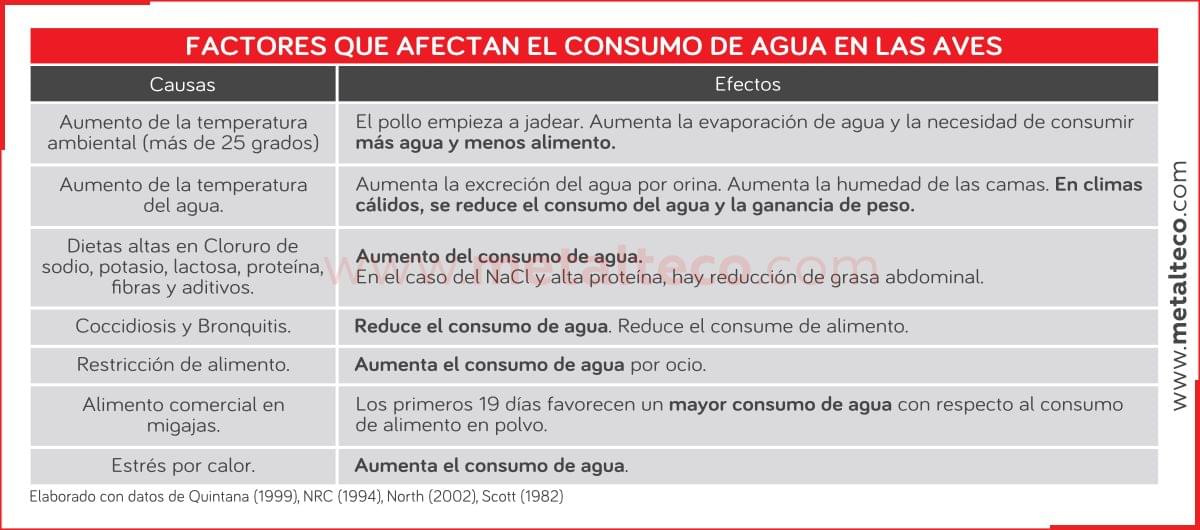
FACTORS AFFECTING WATER CONSUMPTION IN POULTRY TABLE 1
To continue guaranteeing excellence in poultry productivity, the importance of water quality must be considered and the following keys that will lead to production success must be taken into account:
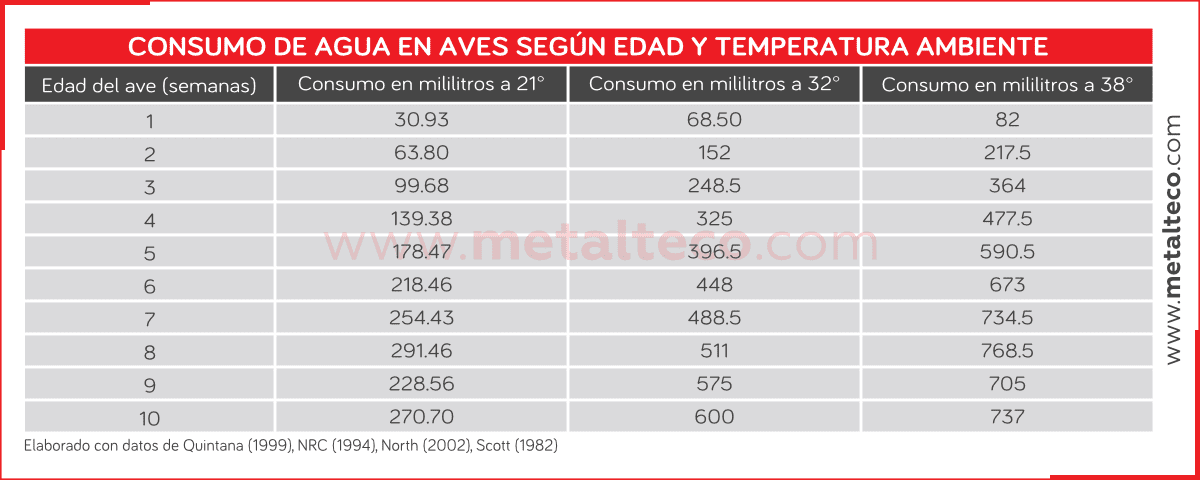
WATER CONSUMPTION IN POULTRY TABLE 2
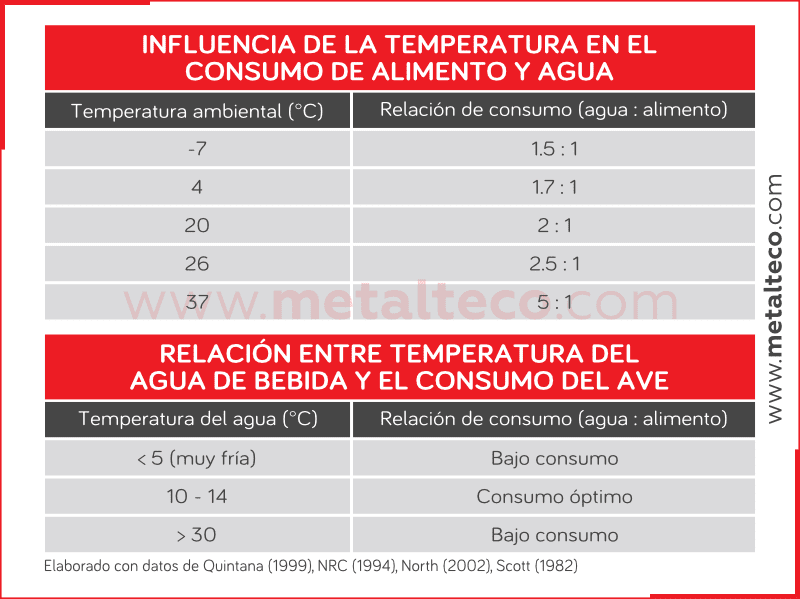
1 Prioritize water quality: Not all producers have a broad level of knowledge of poultry care techniques in this regard. To understand the magnitude of its impact, it is enough to remember that this animal consumes twice as much water as feed. This ratio is even higher in hot climates.
2 Evaluation of the current distribution system: As a first action, the entire system implemented will be evaluated point by point, starting with the water supply and each of the drinking troughs installed on the farm, to determine possible risks or future complications. Surface supplies or shallow wells are usually the most at risk and attract bacteria with flooding.
Taking into account aspects such as the distance of the pipes, whether the route is too long or too short before reaching the sheds or the number of years that the pipe has been installed will indicate whether pipe replacement is necessary and the type of water treatment to be implemented along with basic sanitation times. Checking if there are storage tanks and if those tanks are cleaned frequently is also important.
3 Evaluate water conditions: Some of the signs that will indicate problems in the water are the amount of E. coli and coliforms, alkalinity and pH. Any presence of E.coli or coliforms, or a number greater than 10,000 colony forming units of bacteria, will indicate to the producer if contamination is present and sanitation measures need to be taken.
4 Implement supplements: The producer should choose an inorganic acid rather than an organic acid in order to reduce the pH of water with high alkalinity levels (above 8). Likewise, for acidic water with pH below 4.5 that has low buffering capacity, sodium bicarbonate will be needed as a buffer to improve consumption.
It is recommended to choose the disinfectant according to the pH. You can also use stabilized products to overcome the loss of the disinfectant. Remember that in many cases you will need more than one sanitizing element to use.
5 Establish an ongoing sanitation program: It is necessary to control the application of disinfectant so that it is not applied excessively. The test in this case is the verification of microbial levels: they must be under control, but without excess of disinfectant.
The practice is to standardize residual chlorine levels vs. microbial levels that are considered acceptable. Thus, we will have control in the application of chlorine, chlorine dioxide or hydrogen peroxide.
In conclusion, a good supply of potable water makes a difference in quality and productivity. This “Mission.” needs full staff support and great planning to achieve the objectives.