Whenever we talk about production capacity In a feed mill we think of a value in Tons/Hour. However, in mixing lines the capacity is measured in Baches/Hour.
The size of the pothole is usually measured in weight units (kg or ton) controlled by scales (either in automated batching process or manual scales). Although this bump is measured in this way, the capacity of the mixer is generally defined in volume (liters). Thus, the capacity in Kilograms/Bulk is a function of the specific product to be mixed.
THE SIZE OF THE MIXER:
The choice of mixer size is a strategic decision made by feed plant management. The mixer is commonly referred to as “the heart of the plant” because, unlike other equipment that is a little more flexible in capacity through adjustments in motor power, the maximum volume of the mixeris limited by its constructive characteristics and it is impossible to increase its capacity per pothole without drastic modifications to the equipment.
This is why, in most cases, producers are recommended to install a mixer whose capacity exceeds their specific momentary need, in order to have the opportunity for future growth in the plant without requiring the replacement of the mixer. In addition, it is clear that the size ratio between mixers is not equal to the price ratio: a 2,000 liter mixer does not cost twice as much as a 1,000 liter mixer. The actual ratio is smaller, so it is worth investing in larger equipment that will not limit the plant in the future.
Thus, if the initial production is estimated at 500 liters per hole, it is advisable to install a 1000 liter mixer, whose investment in the future will be much more profitable for the producer.
THE CAPACITY OF THE MIXING LINE:
As mentioned earlier, although the mixer capacity is defined in Liters/Bache or Tons/Bache, the full plant capacity is generally estimated in Tons/Hour. To link these two capacities into a single measure of plant capacity, it is necessary to understand the concept of bumps per hour (or mixing cycles per hour).
A mixing cycle is composed of the following sub-processes:
Filling the mixer.
Mixing of dry materials.
Addition of liquids.
Mixing of wet materials.
Download.
Usually items 2, 3 and 4 in the above list are grouped into a sub-process known as Mixing Time. Thus the mixing cycle can be summarized as:
Filling the mixer.
Mixing time.
Download.
Mixing time may vary due to several factors that can be grouped mainly into 3 groups:
LOGISTICAL FACTORS OF PRODUCTION:
In many plants the number of bumps per hour to be made does not depend at all on the mixer, but on the logistics of the process as such. The speed of pothole preparation is largely influenced, for example, by the degree of automation of the plant. Some of the factors that affect the hourly pothole production capacity of the mixer include:
1 Dosage: in processes with automatic dosing the production capacity of the line is drastically increased. Under ideal conditions (automatic dosing with capacity according to the mixing line and adequate design of hoppers and conveying systems above and below the mixer), capacities of up to 15 bumps/hour can be reached in a paddle mixer. In processes with manual batching, on the contrary, an average of 5 bumps/hour is usually reached, a fluctuating value that depends on the performance of the personnel involved in the batching process.
2 Hoppers: it is of utmost importance to properly design the hoppers above and below the mixer. As for the hoppers above and below the mixer, it is necessary to make sure that they have a capacity that exceeds in volume the mixer capacity. Although there is no predetermined value for this capacity (it depends largely on the manufacturer and available space), it is common for hoppers to be designed with a capacity between 1.25 and 1.5 times the volume of the mixer.
3 Transportation systems: The conveying system must ensure that the hopper over the mixer is fully loaded in the time it takes to mix + unload the mixer. In this way, the mixer loading cycle happens in the right time. The same with the conveying system that removes the material from the hopper under the mixer: it must ensure that the unloading hopper is unoccupied in the time it takes for the mixer loading + mixing to take place. In this way, the discharge of the mixer is fast and there is no interference by remaining material.
MIXER DESIGN:
As seen in previous publications, the design of the mixer has a direct impact on the mixing time and, therefore, on the maximum number of bumps to be made per hour. Usually, the proper coefficient of variation is achieved faster in paddle mixers than in ribbon mixers.
COEFFICIENT OF VARIATION SOUGHT:
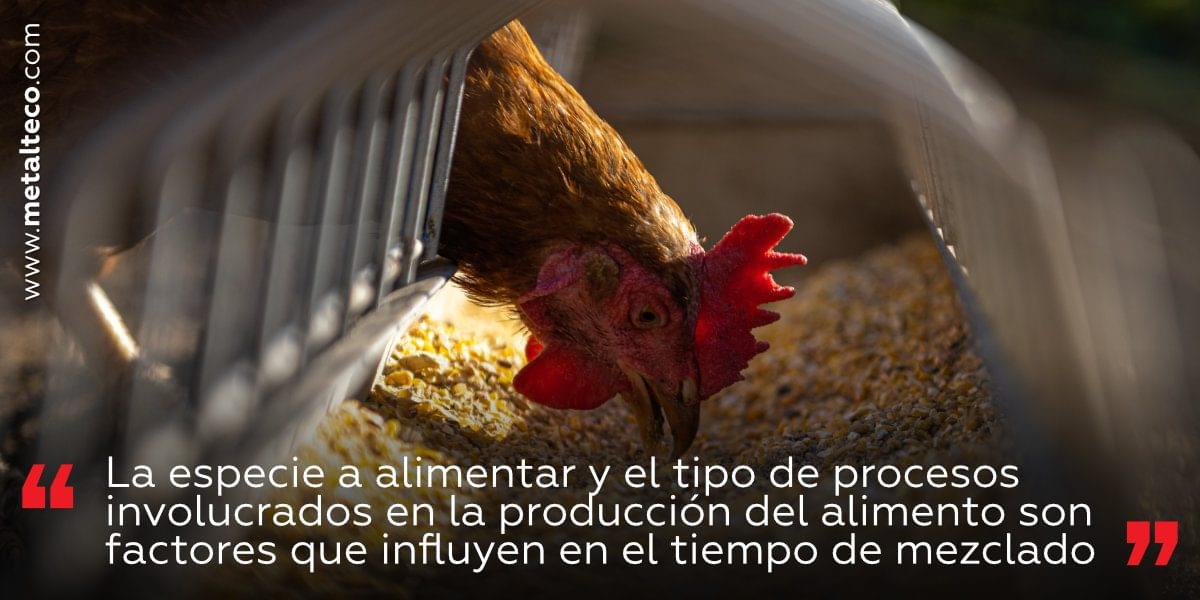
The mixing time is conditioned by the coefficient of variation (CV) sought in feed production. The value considered acceptable for a CV can be 10% for some manufacturers and less than 5% for others. This depends, among other things, on the species to be fed, post-mixing processes and the company's own standards. The lower the CV required, the more mixing time is needed to achieve it.